
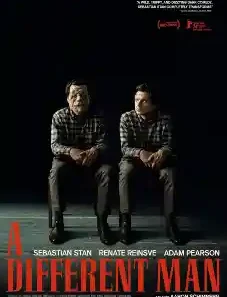
A Different Man (2024) – Complete Review – Zvideo
Genres: Comedy, Thriller
Director: Aaron Schimberg
Writer: Aaron Schimberg
Starring: Sebastian Stan, Renate Reinsve, Adam Pearson
A Different Man (2024) is a daring and thought-provoking blend of comedy and thriller, directed and written by Aaron Schimberg. The film explores themes of identity, social acceptance, and the blurred boundaries between reality and performance. With an ensemble cast led by Sebastian Stan, Renate Reinsve, and Adam Pearson, this movie offers a narrative that’s as unsettling as it is compelling. It tackles disability, societal expectations, and the paradox of inclusion in a way that feels both deeply personal and universally resonant.
Storyline
The protagonist, Edward, played by Adam Pearson, suffers from neurofibromatosis, a condition that causes facial tumors and significantly alters his appearance. Edward’s journey begins with his casting in corporate training videos designed to educate employees on appropriate interactions with disabled coworkers. These videos, although well-intentioned, perpetuate the stereotype of the disabled person as a passive recipient of pity and kindness.
One such video features Edward at a water cooler, where he assures a concerned coworker, “I’m fine, but thank you for asking.” This moment encapsulates the broader societal expectation placed on disabled individuals: to always be gentle, grateful, and non-confrontational. Edward’s character becomes a mirror reflecting the discomfort and underlying biases of those around him. His story raises questions about the authenticity of inclusion and the performative nature of kindness.
As the narrative unfolds, Edward’s reality begins to intertwine with fiction when he lands a role in a stage production about his own life. This meta-layer adds a rich complexity to the film, as Edward is forced to confront not only how others see him but also how he perceives himself.
Themes and Analysis
The Struggle for Identity
At its core, A Different Man is a story about identity—how it’s constructed, deconstructed, and reconstructed in the face of societal expectations. Edward’s disfigurement makes him a visible “other,” someone who can’t easily blend into the crowd. This visibility forces him to navigate a world where people’s reactions range from pity to awkward avoidance.
Through his role in the play, Edward begins to explore the dichotomy between how he’s perceived and who he truly is. The film cleverly uses the medium of performance to highlight how identity is, in many ways, a performance itself. The stage becomes a space where Edward can reclaim his narrative, challenging both himself and the audience to confront their biases.
Disability and Inclusion
Schimberg’s script doesn’t shy away from critiquing the superficial nature of corporate “inclusivity.” The training videos Edward stars in are emblematic of this critique, filled with well-meaning but hollow gestures. The voiceover’s cheerful instructions (“Invite them to social gatherings!”) feel almost patronizing, highlighting the gap between intention and impact.
Edward’s character also challenges the trope of the “inspirational disabled person” often seen in media. Rather than conforming to this archetype, he’s portrayed as a fully realized individual with his own complexities, fears, and frustrations. This nuanced depiction is a testament to Schimberg’s writing and Pearson’s authentic performance.
The Intersection of Comedy and Thriller
One of the most intriguing aspects of A Different Man is its genre-blending. The film oscillates between moments of dark humor and tense, almost surreal sequences. This tonal interplay keeps the audience on edge, mirroring Edward’s own journey of self-discovery and alienation.
The comedic elements often come from the absurdity of societal norms and Edward’s interactions with others. These moments are juxtaposed with the thriller aspect, which is more psychological, rooted in Edward’s internal conflict and the eerie parallels between his life and the play he’s part of.
Performances
Adam Pearson as Edward
Adam Pearson delivers a powerful and deeply empathetic performance as Edward. As someone with neurofibromatosis in real life, Pearson brings an authenticity to the role that’s both rare and impactful. His portrayal is layered, capturing Edward’s vulnerability, resilience, and quiet defiance.
Sebastian Stan and Renate Reinsve
Sebastian Stan and Renate Reinsve provide strong supporting performances. While Stan’s character adds a layer of tension and unpredictability, Reinsve brings warmth and nuance to her role, serving as a counterbalance to the film’s darker themes.
Director’s Vision
Aaron Schimberg’s direction is both precise and imaginative. He uses visual storytelling to enhance the narrative, employing close-ups and dim lighting to emphasize Edward’s isolation. The scenes within the play are particularly striking, blending theatrical and cinematic elements to blur the line between fiction and reality.
Cinematic Elements
Visual Style
The film’s cinematography plays a crucial role in setting its tone. The use of muted colors and stark lighting creates a sense of unease, reflecting Edward’s internal struggles. The contrast between the polished, overly cheerful corporate videos and the raw, unfiltered moments in Edward’s life further underscores the film’s themes.
Sound Design
The sound design is equally effective, with subtle audio cues that heighten the tension. The cheerful voiceovers in the training videos contrast sharply with the more subdued, introspective soundscape of Edward’s personal life. This auditory dichotomy mirrors the duality of Edward’s existence.
Script and Dialogue
Schimberg’s script is sharp and thought-provoking, filled with moments of dark humor and poignant introspection. The dialogue feels authentic, capturing the awkwardness and discomfort that often accompanies discussions about disability.
Social Impact
Representation Matters
A Different Man is a landmark film in terms of representation. By casting Adam Pearson, the film not only provides visibility to individuals with disabilities but also challenges the stereotypes often associated with them. It opens up a broader conversation about the need for authentic representation in media.
Critique of Performative Kindness
The film’s critique of performative kindness is both timely and necessary. In an era where inclusivity is often reduced to buzzwords and token gestures, A Different Man serves as a reminder of the deeper, more meaningful work required to create genuine inclusion.
Conclusion
A Different Man is a bold, genre-defying film that pushes boundaries and challenges societal norms. With its compelling performances, sharp writing, and evocative visuals, it’s a cinematic experience that lingers long after the credits roll. Adam Pearson’s portrayal of Edward is both heart-wrenching and empowering, making this film a must-watch for anyone interested in stories that tackle identity, disability, and the human condition.
While it may not be a conventional comedy or thriller, its ability to blend these genres into a cohesive and impactful narrative is a testament to Aaron Schimberg’s vision. A Different Man is not just a movie; it’s a conversation starter, a mirror, and ultimately, a call to action for a more inclusive world.
Related Article

Bono: Stories of Surrender (A) – Complete Review – Zvideo

Fight or Flight – Complete Review – Zvideo
