
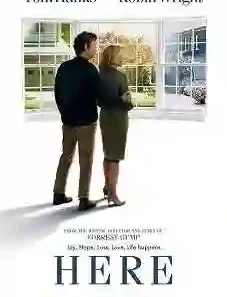
Here (2024) – Complete Review – Zvideo
Here, directed by Robert Zemeckis, is a visually stunning and thought-provoking drama that takes viewers on a journey through time. Written by Eric Roth, Zemeckis, and Richard McGuire, the film uses an innovative narrative technique, employing frames-within-the-frame to transport audiences across different historical periods in a specific location. With stellar performances from Tom Hanks, Robin Wright, and Paul Bettany, Here is not just a film, but an exploration of history, human connection, and the intersection of time.
In this review, we will dive into the intricacies of the film’s plot, its visual storytelling, the performances of the lead actors, and the broader thematic elements that make Here a standout in 2024’s movie lineup.
Plot Overview
The film begins with an expansive, open landscape that sets the stage for a sweeping historical journey. This landscape serves as the canvas upon which a series of events unfold, showcasing the passage of time in a location that seems timeless. We are transported through frames within the frame, each representing different eras that have shaped this space, all while maintaining a sense of continuity.
The story spans several millennia, starting with the extinction of the dinosaurs, moving through the daily lives of Native Americans, and then eventually arriving at the residence of Benjamin Franklin’s estranged son. As the narrative progresses into the 20th century, the focus shifts to a duplex in a more modern setting, where we observe the lives of its inhabitants. The film intertwines personal stories with historical events, drawing connections between the private lives of the characters and the larger cultural shifts of their times.
One of the central storylines in the 1910s focuses on Pauline Harter, played by Robin Wright, who is consumed with anxiety over her adventurous husband, John (played by Paul Bettany). John is fascinated by the emerging field of aviation and spends much of his time fixated on airplanes, which only heightens Pauline’s concerns for his safety and the impact of his obsession on their family life. Through their story, the film explores the tension between personal desires and the responsibilities that come with intimate relationships, as well as the changing perceptions of adventure, technology, and risk-taking in the early 20th century.
Themes and Structure
At its core, Here is about the passage of time and the human experience within it. The technique of frames-within-the-frame, which is used throughout the film, is both a visual and narrative device that underscores the cyclical nature of history. The technique allows the audience to experience multiple time periods simultaneously, creating a layered and complex storytelling structure. As one era fades into another, the film suggests that all of history is interconnected — that each event, no matter how seemingly isolated, is part of a larger, ever-evolving tapestry.
One of the key themes of Here is the idea of place as a witness to history. The film’s location, a specific piece of land, becomes a character in itself, capturing the diverse moments that have occurred over the ages. From the dinosaur era to the time of Native American settlements, from Benjamin Franklin’s household to the early aviation age, the land absorbs and reflects the events of the past. This concept resonates with the idea that history is not just something that happens to people, but that it is tied to the very earth we inhabit. The land is not merely a backdrop but an active participant in the unfolding drama of human existence.
The film also addresses the personal dimension of history. As much as Here explores broad historical moments, it also zeroes in on the intimate stories of the people who lived through them. The characters are not simply passive observers of history; they are active participants in it. Through their struggles, dreams, and desires, the film invites viewers to consider the impact of historical forces on personal lives. It asks: how do individual choices, relationships, and ambitions intersect with the larger currents of time?
In the case of Pauline and John, their personal story is a microcosm of the broader changes occurring during the early 20th century. The advent of modern technology, in the form of airplanes, represents both a leap forward and a source of anxiety. John’s obsession with aviation symbolizes the human drive for progress and exploration, while Pauline’s anxiety reflects the fears that accompany new, uncharted territory. Their relationship is a poignant reminder of the emotional costs of living through periods of rapid technological and societal change.
Visual Storytelling and Cinematic Techniques
One of the most striking aspects of Here is its use of visuals to convey the passage of time. Zemeckis, a master of visual storytelling, employs an innovative framing technique that allows the audience to witness multiple time periods at once. The use of frames-within-the-frame is a nod to the idea that history is not linear, but cyclical. As the film transitions between different eras, the frames shift and change, but the underlying landscape remains constant. This technique highlights the continuity of the land and the way history continuously shapes and reshapes the world.
The cinematography, coupled with the frames-within-the-frame technique, creates a dreamlike quality that blurs the lines between reality and memory. The transitions between time periods are seamless, and the changes in scenery, clothing, and architecture reflect the broader shifts in society, technology, and culture. The use of lighting and color also plays a significant role in setting the tone for each era. The warm, earthy tones of the prehistoric and Native American scenes contrast with the cooler, more modern hues of the 20th-century setting, emphasizing the changes in human civilization over time.
The landscape, as a key element of the film, is not just a backdrop but an active participant in the storytelling. It acts as a silent witness to the events of history, absorbing the stories that unfold upon it. The location becomes a metaphor for memory, history, and the passage of time, underscoring the film’s central themes.
Performances and Character Development
Here boasts an impressive cast, led by Tom Hanks, Robin Wright, and Paul Bettany. Hanks, who is known for his ability to bring depth and humanity to his characters, delivers a performance that is both understated and powerful. His role, while not the central focus of the story, adds a layer of gravitas to the film as he portrays a figure caught in the currents of history.
Robin Wright’s portrayal of Pauline Harter is one of the standout performances of the film. Pauline is a woman caught between the demands of her personal life and the shifting tides of technological progress. Wright captures the nuances of Pauline’s character with subtlety and grace, portraying her internal conflict with a depth that makes her struggle both relatable and poignant. Her anxiety over her husband’s obsession with airplanes speaks to a broader fear of the unknown and the risks that come with innovation and change. Wright’s performance is a testament to her ability to convey complex emotions with minimal dialogue, relying on her expressive face and body language to communicate the character’s inner turmoil.
Paul Bettany’s portrayal of John Harter is equally compelling. John is a man driven by his fascination with the emerging field of aviation, but his obsession comes at a cost. Bettany captures the single-mindedness of John’s character, yet also shows the vulnerability beneath the surface. His relationship with Pauline is strained, and Bettany portrays this tension with a mix of passion and guilt, creating a complex and multifaceted character.
The chemistry between Wright and Bettany is palpable, and their interactions form the emotional core of the film. Their relationship is fraught with tension, but it is also filled with moments of tenderness and longing. Their performances complement each other perfectly, with Wright bringing a sense of quiet strength and vulnerability to her role, while Bettany brings a sense of restless energy and ambition.
Conclusion
Here is a cinematic achievement that blends history, personal drama, and visual storytelling into a compelling narrative. Robert Zemeckis has crafted a film that not only explores the passage of time but also the emotional and psychological impacts of living through it. The innovative use of frames-within-the-frame creates a unique viewing experience that allows the audience to witness multiple time periods simultaneously, adding depth and complexity to the film’s exploration of history and memory.
The performances by Tom Hanks, Robin Wright, and Paul Bettany are exceptional, with each actor bringing nuance and depth to their roles. The film’s themes of technological progress, personal relationships, and the intersection of history and memory are thought-provoking and resonate long after the credits roll. Here is a film that challenges conventional storytelling and invites audiences to reflect on the ways in which time shapes us all.
Related Article

Angel of Beggars 2025 – Complete Review – Zvideo

Fragile Heart 2022 – Complete Review – Zvideo

