
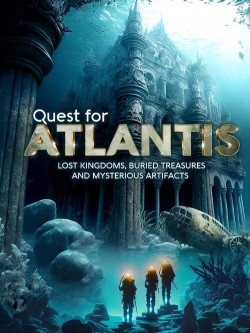
Quest for Atlantis: Lost Kingdoms, Buried Treasures and Mysterious Artifacts (2023) – Complete Review – Zvideo
The legend of Atlantis has been one of humanity’s most enduring and mysterious tales, captivating the imaginations of scholars, explorers, and adventurers for centuries. Atlantis, the fabled city said to have been destroyed by a cataclysmic event, has sparked debates about lost civilizations, ancient technologies, and the limits of human history. Now, the 2023 documentary Quest for Atlantis: Lost Kingdoms, Buried Treasures and Mysterious Artifacts brings this age-old mystery to the forefront of modern exploration. In this comprehensive review, we’ll explore the documentary’s premise, findings, and implications on our understanding of the ancient world.
Introduction to the Quest for Atlantis Documentary
Released on January 1, 2023, Quest for Atlantis: Lost Kingdoms, Buried Treasures and Mysterious Artifacts takes viewers on an enthralling journey to unravel one of the greatest mysteries in human history. This documentary, produced by Reality Entertainment (RE), delves deep into the idea of Atlantis, exploring the possibility that the lost city was not merely a myth but a real, ancient civilization. The film brings together historical analysis, modern archaeological research, and stunning visuals to present a compelling case for the existence of Atlantis.
Cast and Narration:
The documentary is hosted and narrated by Charles Thompsen, an expert in ancient history and archaeology. Thompsen guides viewers through the latest discoveries that suggest Atlantis might not just be a product of Plato’s imagination. His insights and analysis offer a balanced perspective, allowing the audience to appreciate both the mystery and the scientific breakthroughs that are slowly piecing together the puzzle of Atlantis.
The Myth of Atlantis: A Brief Overview
The myth of Atlantis dates back to ancient Greek philosopher Plato, who first introduced the story in his dialogues Timaeus and Critias around 360 BC. According to Plato, Atlantis was a prosperous and technologically advanced civilization located beyond the “Pillars of Hercules” (modern-day Gibraltar). Atlantis was said to have been a powerful empire, rich in wealth, culture, and innovation, but it fell out of favor with the gods and was submerged into the ocean in a single day and night of catastrophic flooding.
For centuries, many believed the tale was purely allegorical—a philosophical lesson about the rise and fall of civilizations. However, the allure of Atlantis remained strong, and the idea that it might be a real, lost city persisted throughout history. This is where Quest for Atlantis comes into play, offering a fresh perspective based on new discoveries that challenge the traditional view of Atlantis as myth.
New Discoveries That Could Rewrite History
The most exciting aspect of Quest for Atlantis is its examination of recent archaeological finds that suggest Atlantis may have been a real place. Over the last few decades, there have been several groundbreaking discoveries that point to the existence of advanced ancient civilizations long before the known historical record. The documentary highlights several key findings that challenge the idea that Atlantis is merely a fable.
Ancient Maps and Underwater Discoveries
One of the central revelations in the documentary is the discovery of ancient maps that seem to indicate the presence of an advanced civilization in the area where Atlantis is believed to have existed. These maps, dating back to several centuries before Plato, suggest that ancient cultures had knowledge of far-off lands and sophisticated navigation techniques.
Perhaps the most notable underwater discovery featured in the film is a mysterious structure found beneath the ocean near the Azores, an archipelago in the North Atlantic Ocean. This submerged structure bears striking similarities to ancient temples and cities, with precise geometrical shapes and massive stone blocks that appear too advanced for the time period they are thought to belong to.
Mummies and Ancient Artifacts
The documentary also explores the unearthing of ancient mummies and artifacts from various underwater excavations. Some of these mummies, found off the coast of Cuba and other Caribbean islands, exhibit unusual features, such as elongated skulls, that suggest they may not belong to the indigenous populations known to have lived in the region. These findings raise questions about the people who may have lived in the area thousands of years ago, possibly linked to the lost civilization of Atlantis.
In addition to the mummies, the documentary showcases an array of underwater artifacts that seem to align with descriptions of Atlantis in ancient texts. These include intricate carvings, ancient stone tools, and sculptures that bear striking resemblances to those described in Plato’s writings. The documentary speculates that these artifacts could be remnants of a lost kingdom, submerged by a natural disaster like the tsunami Plato mentioned.
The Underwater Stonehenge and Monoliths
One of the most intriguing discoveries highlighted in Quest for Atlantis is the finding of an underwater “Stonehenge” structure. Situated deep in the ocean off the coast of Japan, this ancient formation bears remarkable similarities to the famous Stonehenge site in England. Composed of large, upright stones arranged in a circular pattern, the underwater Stonehenge may be evidence of a highly advanced civilization with knowledge of astronomy and engineering.
The documentary also explores the discovery of monoliths scattered across various underwater sites, particularly in the Mediterranean Sea. These massive stone structures are often too large and complex to have been created by primitive societies, leading researchers to speculate that they could have been built by a highly advanced culture—possibly the Atlanteans.
Ancient Drawings and Symbolism
Another fascinating element of the documentary is the exploration of ancient drawings and symbols that may be linked to Atlantis. Cave paintings and carvings found in places as diverse as South America, the Middle East, and Europe depict strange, otherworldly creatures and geometric patterns that resemble those described in ancient texts about Atlantis. These symbols, which appear in isolated locations around the world, might represent a shared knowledge or belief system among the peoples who once inhabited the Atlantic region.
In the documentary, scholars suggest that these symbols could be part of a greater cultural network that connected civilizations across the globe, potentially supporting the theory that Atlantis was a central hub of advanced knowledge and technology.
Theories and Speculations About Atlantis
While Quest for Atlantis offers compelling evidence, it also presents a variety of theories and speculations about what happened to the lost kingdom. Some scholars argue that Atlantis was destroyed by a massive tsunami, while others suggest that it could have been wiped out by volcanic eruptions or even a meteor impact. The documentary raises the possibility that the survivors of Atlantis may have spread across the world, influencing other ancient cultures and civilizations.
Another intriguing theory presented in the documentary is that the fall of Atlantis may not have been a single event but rather a gradual decline, caused by environmental changes, internal strife, or external invasions. The theory of a gradual decline fits with the historical record of other ancient civilizations, which often experienced periods of prosperity followed by collapse.
Implications for Modern Archaeology
The findings presented in Quest for Atlantis have profound implications for modern archaeology and our understanding of ancient civilizations. If the discoveries featured in the documentary are validated, they would force historians and archaeologists to reconsider the timeline of human history. The existence of advanced civilizations long before recorded history could change everything we know about the development of human societies, technologies, and cultures.
Moreover, the documentary raises important questions about how ancient civilizations communicated and exchanged knowledge. The discovery of shared symbols and architectural features across distant cultures suggests that there may have been a lost global network of knowledge that connected ancient peoples.
Conclusion
Quest for Atlantis: Lost Kingdoms, Buried Treasures and Mysterious Artifacts is more than just a documentary about a lost city—it’s an invitation to challenge what we think we know about history. The discoveries featured in the film provide tantalizing clues that may one day lead to the confirmation of Atlantis as a real, advanced civilization. However, as with all mysteries of the past, the truth may remain elusive for some time to come.
The film is a fascinating exploration of one of humanity’s oldest mysteries, and it serves as a reminder that our understanding of history is far from complete. As new discoveries continue to emerge, the quest for Atlantis will undoubtedly continue to captivate and inspire future generations of explorers, scientists, and historians.
Related Article

The Three Michaels (2024) – Complete Review – Zvideo

Becoming Hitchcock: The Legacy of Blackmail (2024) – Complete Review – Zvideo